
I can’t remember a time when Jim Woodrings’s Frank wasn’t a reliable staple of the indie comics landscape. The trippy paintings that graced the covers of every single issue left an indelible mark on my psyche whenever I came across them in the back issue bins at my local shop. I even remember the title being featured in the Palmer’s Picks column in Wizard Magazine: The Guide to Comics when I was a faithful subscriber in my teenage years. All of this is to say that Woodring is an absolute master of the craft and has been proving it for over thirty years now.
Frank, at first blush, is a simple funny animal comic like Scrooge McDuck or Pogo but with something far more complex and malevolent going on between the panels. It’s truly the mutant offspring of the “rubber hose” animation style of Fleisher Studios and early Walt Disney as filtered through the lens of underground comix from the sixties, eastern mysticism, and set in the world of the Codex Seraphinianus.
The series follows the titular saucer-eyed any-animal through numerous fables of ambiguous morality that take place in an ever-shifting land known as The Unifactor. Frank’s adventures span from the original 1991 series of comics, now collected in omnibus volume The Frank Book, to graphic novels like Weathercraft and One Beautiful Spring Day, through monographs like And Now, Sir… Is this Your Missing Gonad and Frank in the Third Dimension, and even a yearly calendar.
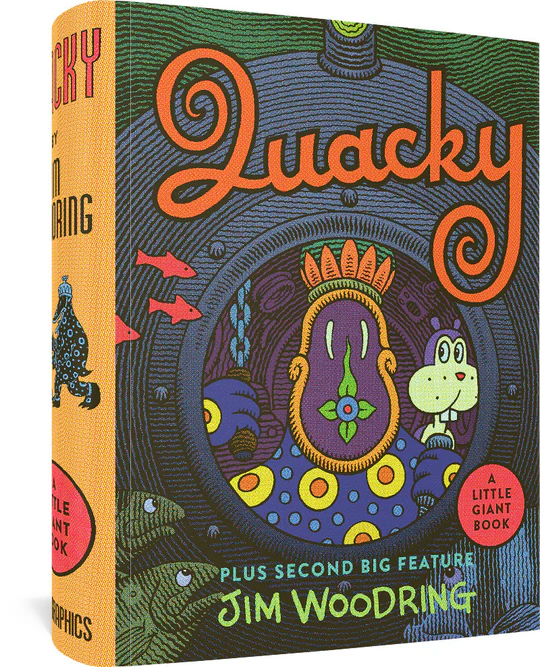
With Quacky, Woodring adapts his Frank opus to another unusual format: the Big Little Book. These books were compact, usually measuring about 4 inches tall and three and half inches wide with a thick spine. They contained simple and heavily illustrated children’s stories and tended to feature pop culture characters of the time like Dick Tracy, Tarzan Mickey Mouse, and Buck Rogers and sometimes adapted literary classics and comic strips.
These little volumes are treasured among booklovers and also, as Quacky makes very obvious, Jim Woodring. Through the art style, approach to the text and even the paper stock used, Quacky easily blends in with any of the vintage installments with only its clean modern cover and design to give it away. Somehow Frank is singularly well-suited to take full advantage of this format. Even though the book is miniature in stature, Quacky provides new depth not seen in Woodring’s previous Frank adventures.
The main story in Quacky kicks off with an invitation, resentments, and a gift that hides something unexpected. Many of the usual cast of characters appear, including his pets Pupshaw and Pushpaw and the forever maligned Manhog who acts as a sort of karmic other half to Frank. Events unfurl in unexpected and surreal ways and, like most Frank stories, the particulars of plot matter far less than the journey throughout the strange corners of the Unifactor.
I felt a constant sense of dread while reading Quacky. This isn’t unusual for Woodrings’s Frank stories but it’s more pronounced here, honed by his rich and unsettling prose style and previously unheard interiority for the character. Quacky somehow manages to drag Frank into the genre of folk horror here. There is a quiet but unsettling doom hiding beneath a pastoral setting that constantly threatens to swallow up Frank and his cohorts as they go about their lives. The Unifactor is an entity to itself and uses its mysterious power to imprison Frank in a cycle where he must witness pain and misfortune over and over and over again.
The backup feature, Cunningham The Pig Who Helps All His Friends, tells the story of a group of cartoon pigs who are concerned by the unexpected mayhem caused to their pastoral town by a member of their gang. What starts as a pastiche of 1950’s Americana slowly descends into a disturbing examination of the frailty of not only the structures of our society but also the nature of reality itself. Essentially, it’s the Three Little Pigs as directed by David Lynch.
As with Quacky, Cunningham highlights just how adept Woodring is at spinning an absurdist tale. The characters are well drawn, both in words and pictures, and the story of unraveling social order is as much of an indictment of the toxic illusions of our past as it is the unreal times we find ourselves in currently.
Quacky stands up as one of Woodring’s best works, inside and out, and enriches the entire Frank series with its miniscule presence. Like the gifts Frank receives throughout his story, this book unfolds in exciting and mysterious ways. It’s cliche to say that good things come in small packages but it definitely holds true here.
Quacky is available for pre-order here from our friends over at Fantagraphics.
About Author


