
It was cold. Autumn was just creeping into the night air in rural Minnesota. At first it looked just like a satellite drifting slowly above me. Then it stopped. At first I thought my eyes were playing tricks on me but then it zipped quickly over in a ninety degree angle. It sat again for a moment before streaking off in a completely different direction like a shooting star, tail and all.
The sky is wide open there. It’s hard to describe just what the canopy of stars looks like in a place like that, without light pollution degrading the natural majesty of the night, truly feeling the infinite spread out in front of you. This is why it didn’t surprise me that I was able to see a UFO (you’re never going to get me to call them UAPs) while I lived there. That’s not to say that it didn’t inspire a significant shift in my belief of otherworldly things, though. It jostled my core so hard that I still think about it twenty five years later.
My encounter wasn’t anything like what I had seen profiled on Unsolved Mysteries or in movies like Fire in the Sky. No, this was downright mundane. It was so outwardly boring that people would never take it seriously if I tried describing it.
There’s a very particular feeling to experiencing something like that, seeing a thing so out of the ordinary that you struggle to communicate it to others without looking crazy, stupid, or naive. It makes total sense to me that someone might turn to poetry to try conveying something so complex and mystifying to others.
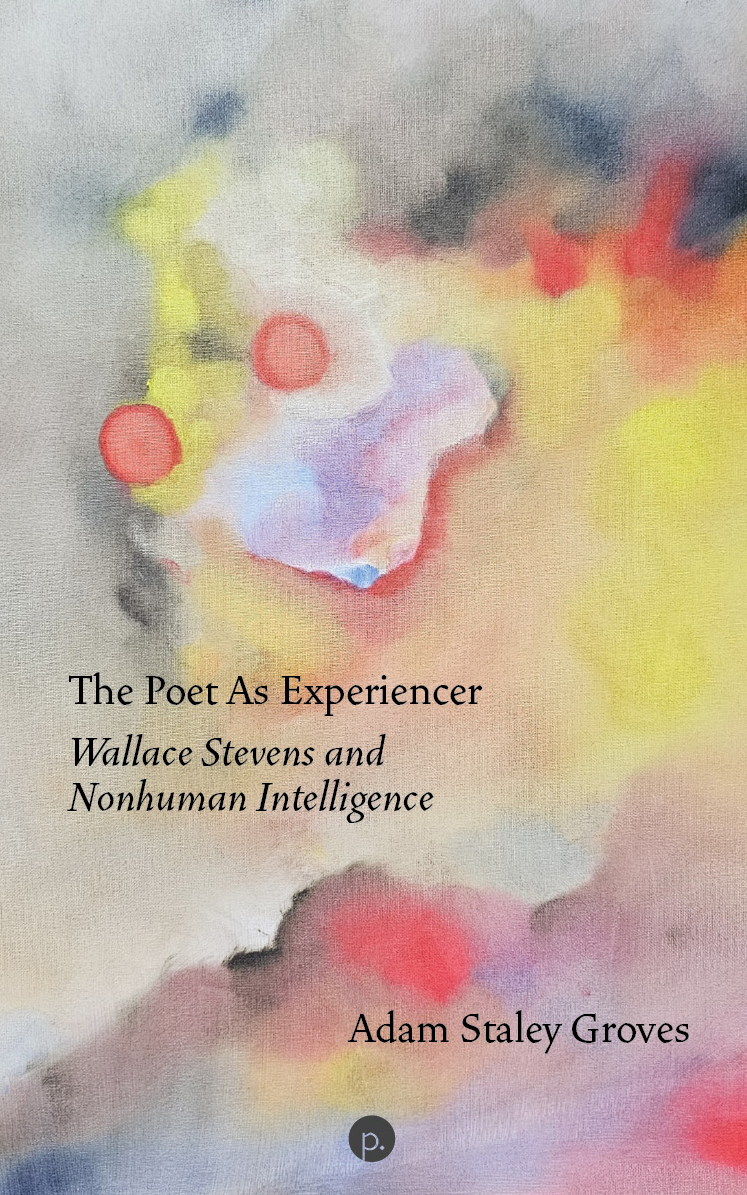
Maybe this is why The Poet as Experiencer: Wallace Stevens and Nonhuman Intelligence by Adam Staley Groves resonated so deeply with me. It examines Stevens’ work from the point of view of someone who was both psychologically and spiritually impacted by an encounter with something beyond normal understanding. Grover makes a compelling case through a variety of passages pulled from both published and unpublished poetry, journal entries, and other writings, showing that Stevens very well may have been describing phenomena he had experienced that predated the language we now have to define it.
Wallace Stevens was a prolific American poet and thinker born in the late 1800’s, long before radio and television and even longer before UFOs, aliens, and Nonhuman intelligences had saturated popular culture. That makes this particular appraisal of his work both compelling and hard to consider without the voice of my inner skeptic nagging in the background the entire time. I admit that I find Grover’s arguments fascinating, especially his theory that Stevens’ used his work as a kind of coping mechanism to deal with whatever it was that he may have experienced in his past. The signs are all there: orbs, owls, little people with strange eyes, missing time, reptilians. Everything that would later define the entire spectrum of otherworldly visitations. It’s up to the reader to decide whether or not Stevens had truly experienced something alien or if the alien that he was encountering was a nonhuman entity conjured up from within himself. As Adam Staley Groves says at one point:
Poetry presents the proof of an intelligent other which its technology appropriates.
I wasn’t aware of Wallace Stevens or his writing before reading The Poet as Experiencer. At first I thought this might be a barrier to entry but found the book plenty engaging as a study of an artist in communion with the source from which his art truly emerges. Stevens was a man with a surplus of ideas about poetry, creativity, and the world around him and it’s interesting to think about the origins of his way of thinking as it is filtered through the various esoteric lenses that Grove uses in his autopsy of the vast catalogue of work that he left behind.
It’s hard to imagine what it may have been like for Wallace Stevens if Groves is correct in the theories contained within The Poet as Experiencer. How would someone truly process an interaction with the nonhuman and create the language needed to express something so completely alien and unrecognizable? How would someone deal with something both traumatic and awe-inspiring? It’s possible that the answer to that is through poetry.
About Author


