
Thirty years ago I thought of anarchy as this singular thing. The overwhelming pop cultural definition had taken root, the one that considered it to be nothing more than chaos and destruction. It was the stereotypical punk on TV with a gigantic mohawk spray painting an A with a circle around it on the wall before breaking a window and lighting a shop on fire just for fun. My entire vision of the philosophy was modeled on what I saw on reruns of Quincy, M.E and C.H.I.P.S or on random episodes of The Jerry Springer Show or Maury.
In rural Minnesota, before the internet, it was difficult to see beyond that. It was ignorance but I have to argue that it was no fault of my own. The resources just weren’t there for me to learn any better and so I continued on like a good little liberal in an overly conservative region of the state. It’s not lost on me that Perspectives on Anarchist Theory was just getting off the ground at the same time and would’ve hit me with laser precision had I known it existed back then.
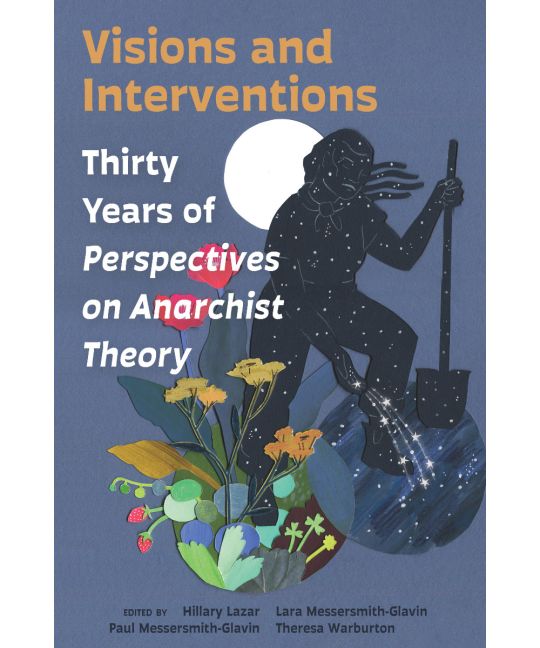
Visions and Interventions: Thirty Years of Perspectives on Anarchist Theory conjures up a vastly different timeline for me, one where I saw beyond the stereotype and learned a better spectrum of anarchist thought, one where I found myself radicalized far earlier than I have been. I’ll be the first to admit that I’m still new to a lot of the varying approaches to anarchism so part of me is both wishing that this had been the timeline I was inhabiting for the last thirty years and glad that, in this timeline, I am given a collection such as this to pore over and have my blinders chipped away and horizons broadened.
Visions and Interventions presents a broad cross section of essays from across the publication history of Perspectives, featuring essays about things as diverse as grassroots alternatives to emergency medical services and community support for anarchist mothers to anarcha-feminism and using performance art to communicate the climate crisis. It’s also full of interesting interviews about social justice science fiction, Chinese anarchism, black radicalism, and German anti-authoritarianism. It’s a truly impressive range of subject matter.
Like any anthology there are essays that I loved, essays that changed the way I thought about something, and essays that just didn’t do anything for me. Like the broad potential of anarchy itself, there are a myriad of approaches to theory and praxis that can be adopted or discarded as one sees fit. It goes beyond intellectualized arguments and philosophy, giving practical knowledge and real world applications for radical models and methods to exist in our world.
I appreciated the range of voices contained in this anthology. The editors talked in the introduction about how they found it important to include laymen and first time writers, both in their newsletter and collected here, and their voices provided a breadth of knowledge and experience not necessarily shown by some of the more well represented proponents of these ideas. They also gather a large variety of people from different backgrounds and cultural heritages who bring perspectives I hadn’t seen before and reinforces just how vital it is to read as broadly as possible.
Here are a few of the essays that stood out for me. This isn’t a measure of quality by any means. I got something out of almost everything in this book but these just hit me a little harder.
Place as Message: Anarchist Climate Change Communication Through Performance by Taiga Christie centered around a performance about climate change communication during COVID. I had never heard of the scientific report it was based on, wherein things like atomic priesthoods and genetically modified cats were suggested to communicate the dangers of the Yucca Mountain nuclear waste repository.
Signs of the Revolution: Deaf Justice and Anarchist Praxis by Tristan Wright introduced me to the concept of autism and how our culture favors those who can hear while ignoring the needs of those who can’t. The idea that people have died from police using only auditory commands or smoke detectors being primarily sound based is heartbreaking and this article outlines ways to bring about some kind of equity.
Interviews from an Uprising provides an oral history of the protests that arose after the police in Ferguson, Missouri murdered Mike Brown and Eric Garner in 2014. The street level stories show a tragedy as it was unfolding and somehow is still repeating through the continued abuses by authorities now.
An interview with Barbera Epstein written in 1998, called The Need for Critique, The Need for Politics by Rebecca DeWitt, stood as a stark reminder that we live through cycles of radicalism and alienation. A quote is pulled from one of Epstein’s books and it has really stuck with me: if alienation drops from our vocabulary, we have no reason to pretest current conditions and no basis for imagining anything better.
Time Under Tension: Lessons in Organizing from a Kettlebell Gym by Lara Messersmith-Glavin approaches their views on transformation and building affinity from the engaging angle of their work at Bleeding Hearts Kettlebell Club in Portland, Oregon.
Breaking the Chains of Command: Anarchist Veterans of the US Military by Brad Thompson explores the unexpected path toward radicalism that can be found within military service. I’ve known a good amount of veterans over the years and this essay was enlightening as to what led a few of them toward a more anarchistic point of view. It has to truly be difficult to find ways out of the environment of oppression and domination of military life and it’s good to see that some are up to that fight.
Theresa Warburton’s Coming to Terms: Rethinking Popular Approaches to Anarchism and Feminism explores the tenuous relationship between these two philosophies and the need to both address and eradicate gendered violence in radical communities.
An Homage to David Graeber and to the Transformative Power of the Imagination serves as a great overview of Graeber’s work and interesting interpretation of how much the imagination meant to both him and radical movements as a whole. It’s clear that the only way forward is to imagine what we want and go toward it however we can.
Visions and Interventions presents a truly egalitarian vision throughout. You can’t build a better future without ideas and dreams like those contained in this collection of essays. As Rebecca DeWitt wrote in her essay in the book, An Anarchist Response to Seattle: What Shall We Do with Anarchism:
Anarchism is a sense of injustice in our world, faith in humanity’s potential to transcend social structures that produce injustice, and the obligation to do something about it.
The editors Hillary Lazar, Paul Messersmith-Glavin, Lara Messersmith-Glavin, and Theresa Warburton, along with The Institute for Anarchist Studies and AK Press, have done us all a great service in crafting Visions and Interventions and continuing to archive the ongoing work in Perspectives on Anarchist Theory. They have built an incredible primer and dispeller of misconceptions with this title.
About Author


