
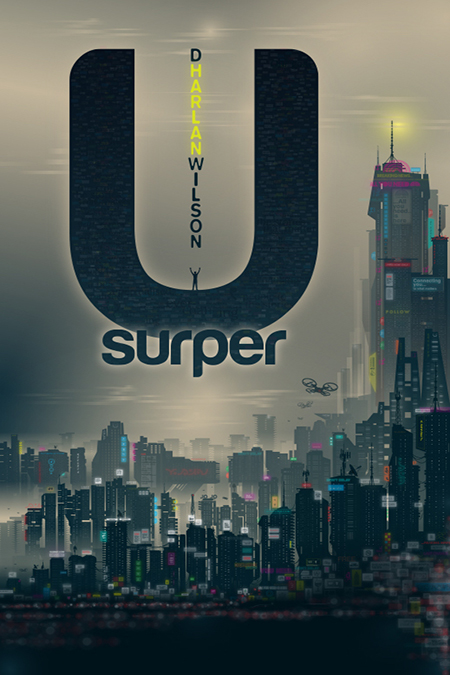
I’ve been reading for long enough and with a broad enough reach that I feel like I can usually categorize the kind of book I’m reading with the same standard that Supreme Court Justice Potter Stewart defined obscenity (I know it when I see it). Usurper, the newest book by D. Harlan Wilson, defies that most basic standard of categorization. It vacillates between the forms of a novel, an absurdist examination of film, a brutal parody of celebrity and mass culture, and a sideways manifesto of filmic psychogeography with little or no warning before each shift in perspective and genre occurs.
On its wrapper the book tells the story of Caliban Ogg and a group of misfits loosely adapting the work of James Joyce for film. It’s also a sequel to one of Wilson’s previous books, Outré, which tells the story of Ogg’s father and approaches Hollywood in abstract through the lens of Melville’s Moby Dick. In truth, if you want to call it that, it is something else entirely.
As Wilson says in this book:
“In the schizoverse, one can jump from consciousness to consciousness, body to body, irreality to alt-reality to anti-reality like a Catholic demon in heat. Everybody always gets lost in the schizflow and is too lazy to find a way home.”
Usurper never settles into one place, one character, one timeline, into the past, or toward the future. It’s everywhere and nowhere, all at once. Dream logic and hypnagogic flows of events bump together like tectonic plates in constant collision. Scenes sway from fiction to non-fiction and shift in time and points of view. The entire narrative is as volatile as nitrate film passing in front of a lamp that’s running too hot. We are lost in the schizflow for the duration.
If there was a clear line to be followed in this book I could not find it but I also truly didn’t care. Wilson’s control of language and narrative is masterful so these cascading realities are spread out before you with the same artful flourish that he and his contemporaries on the more experimental side of Bizarro fiction like Steve Aylett always bring to the table. Even the formatting, with each chapter broken into a semi-automatic blast of shorter and only somewhat related segments, keeps you off balance and wondering what might hit you next.
Usurper makes it abundantly clear that D. Harlan Wilson is truly fascinated by the more idiosyncratic contours of film and its surrounding culture. His theories on filmic consciousness, explored in previous books like the aforementioned Outré and Strangelove Country, can be seen creeping in the shadows of the book and enriching the entire text. Much of the book revolves around the inevitable conflict between commerce and art in cinema and it leverages a nearly insurmountable influence on Caliban Ogg’s anti-oedipal production of James Joyce’s “Doomsday” Ulysses and is embodied by an overbearing entity known as The Studio. It’s hard not to see an authorial sneer at the content-mill blockbusters and the franchise cash grabs that populate the current cinematic landscape.
As a fan of both movies and unusual literature I found Usurper to be engaging, confounding, and utterly original. I can’t recommend it for everyone but it definitely did something for me, even if I can’t quite figure out how to categorize it.
About Author


