
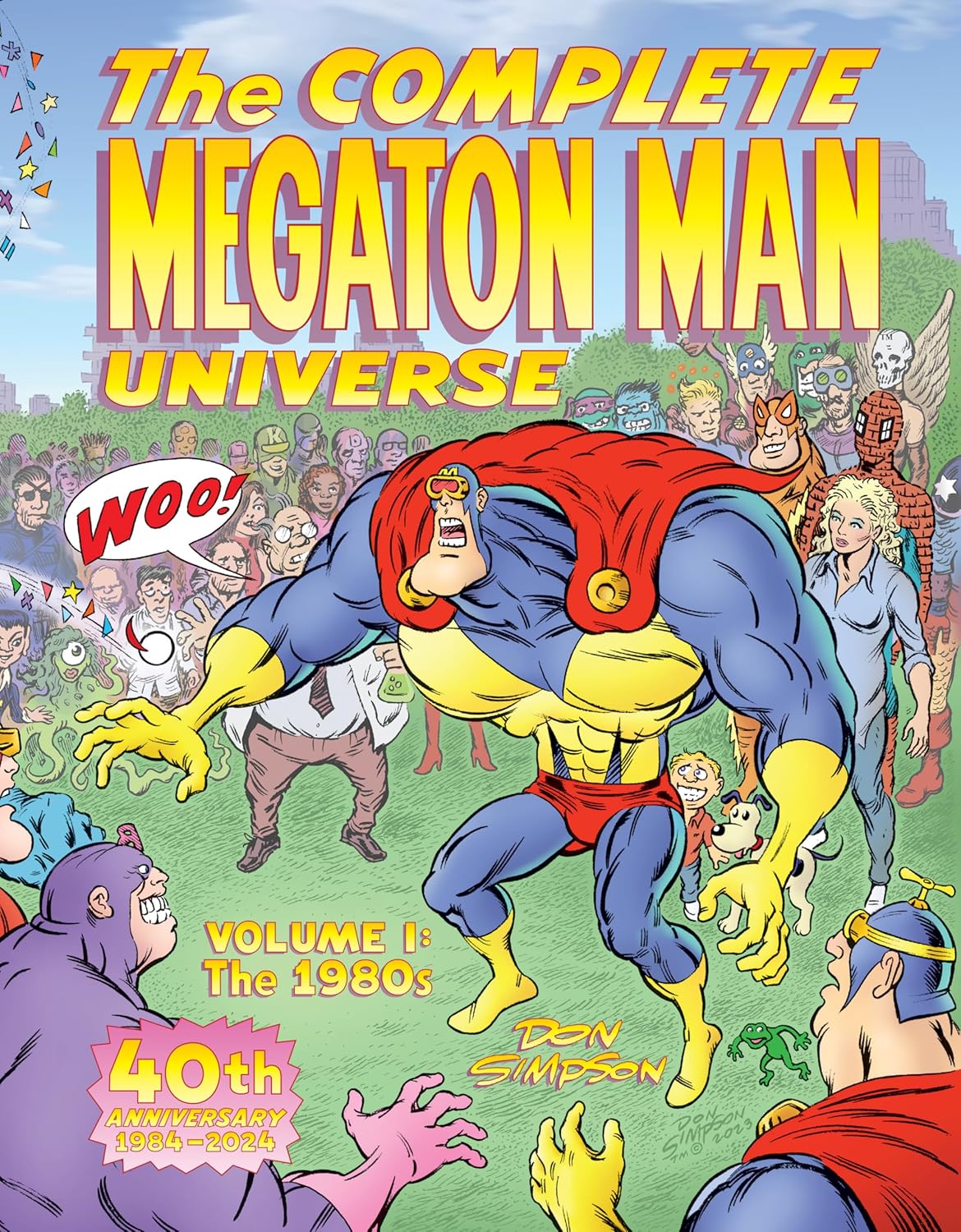
Donald Simpson has always held an outsized presence in my life as a comic book fan. I was a shameless bin-diver in my teenage years. My local comics shop had their “schlock” boxes and I would spend hours rifling through them for whatever hidden treasures I could find. I’ll admit that I wasn’t exactly hunting for gold; I would settle for whatever overstock Valiant books or b-list Image spinoffs I could get my hands on. The ratio was probably around ten stinkers for every random issue of Love & Rockets or string of Baron and Rude’s Nexus but I didn’t mind.
This was how I was first introduced to Don Simpson’s Megaton Man. I was already familiar with Simpson, having been pointed to the art lessons he would put up on his website by posters on a comic message board. There were only a few random issues hidden away in those long boxes so I was never able to piece together a full collection or even what the series was really about. At the time wrote it off as a simple parody of superheroes like The Tick. I wish I had known then that it was far more complicated than that. This is why I feel like hardcore fans like me are lucky right now because huge collections like The Complete Megaton Man Universe, Volume 1: The 1980s keep bubbling up to the surface to fill in those tectonic gaps in the landscape of our comic knowledge.
The Complete Megaton Man Universe, Volume 1: The 1980s is gigantic, containing over 600 pages of material. Inside you’ll find all ten issues of the original series, the entire The Return of Megaton Man miniseries, a pair of one-shots focusing on peripheral characters, a couple short comics, an expansive afterword and so much more. This book is a genuine slab of comics culture, coming from Fantagraphics Underground.
Don’t get me wrong: Megaton Man is a parody, through and through. It confronts the utter absurdity of Silver Age comics, superhero worship, and even the idea of whether or not superheroes should be considered a serious genre at all. Our titular hero is a transparent Superman analog: he has super strength, he can fly, and he even has an alter-ego that’s a journalist. Unlike Superman, Megaton Man is a complete idiot with absolutely no clue about the cosmic chaos going on all around him. The rest of the cast is filled out with similar jabs toward characters of the silver age, with askew stand-ins for the rest of Superman’s regular foils like Lois Lane and Jimmy Olson, alongside pokes at the Fantastic Four, Silver Surfer, Nick Fury, and the X-Men.
The stories themselves are just as firmly planted in the cheesiness of the sixties and seventies. The main arc of the original series follows the Cosmic Cueball, an all-powerful macguffin that launches an over-the-top spoof that touches on things as broad as the function of governments in the creation of superheroes, the male gaze and the overtly sexualized role of female comic characters, and the realities of how ineffective an alter ego would really be. Later, in The Return of Megaton Man, Simpson tackles murky comic continuities and the self-serious broodiness of the late eighties by attaching our hero to a variety of disposable teams of teenage Mega-heroes and sidles him with newfound insecurities about his own super-heroic identity.
Most great parodies are inextricably linked to the time they are created and Megaton Man is no different. It makes the stories far less timeless but that hardly matters when it’s something this good. The series is firmly planted in the eighties, with its cold war era jabs at Russia and the cloud of nuclear proliferation that hung over America at the time. There is even the vestigial inspiration of the underground comics scene of the sixties filtering through Donald Simpson’s quintessentially eighties indie book, showing signs of Robert Crumb and Gilbert Shelton in both its decadence and humor.
It’s not just all about the jokes, though. There are moments of stillness and complexity, too. The fifth issue of the original series is an emotional gut-punch, exploring the isolation and longing for intimacy felt by See-Through Girl, a woman who has the power to control how people perceive clothing and the wife of a highly flawed and abusive super-scientist. The first issue of The Return of Megaton Man finds the titular hero wanting nothing more than a regular life while exploring identity and how the expectations of others mold how someone like him might see himself. It pulls Megaton Man from parody to the edge of tribute and nearly integrates it into the genre it seems to poke fun at.
Don Simpson’s art changes in subtle ways throughout this volume. The artistic DNA of Wally Wood, especially his Superduper Man feature from MAD Magazine, can be seen in Simpson’s rich brushwork and heavy detailing during the early run. Those details begin to disappear as Simpson allows the original coloring (which isn’t reproduced in this book) to do more of the heavy lifting and further develops his own signature style, shedding much of the overwhelming chiaroscuro and washes that defined the original series. There is a feeling that something is missing in the latter issues. It could just be the natural shortcomings of a black and white reprint of a color comic or it could be that Simpson worked his pages less and less over time.
Another thing that slowly fades into the background is the extreme grotesquery of Simpson’s human forms. Characters are either mountains of bulbous muscle or innocent pixies with exaggerated heads and manga-esque eyes. It may be the most obvious satire in the comic but it is also a great commentary on the medium by creating an environment where our Mega-heroes are invulnerable bastions of flawed masculinity while everyone else takes on the physicality of fearful innocence. Even the president, modeled after an extremely overweight Orson Welles, displays his personality through presentation just as much as through dialogue. This visual shortcut all but disappears by the end of this volume and I feel that the work is weaker for it.
Simpson’s later style is one that I was very familiar with, mostly from frequenting his website and reading the drawing tutorials he had shared there. Simpson’s style still shows through but there’s a more realistic flavor to it. It doesn’t have the same verve as the earlier, more inexperienced work. It isn’t remotely bad but I think it lacks the dynamism and immediacy of the mutated exaggeration found in the early issues.
The sheer volume of ephemera in the end of this book was a welcome surprise. Seeing all of the ads, pinups, and even the letter columns through the book made this feel like a true effort of love, not only for the work itself but also its longtime fans. My favorite part by far were the “deleted scenes,” entire sequences of pages scrapped for one reason or another that Simpson had squirrelled away and included here. It’s a true archive of the early days of Megaton Man and not just a collection of issues slapped together for a nostalgia payday.
There is something that Donald Simpson said in the afterword that I feel perfectly sums up what Megaton Man and The Complete Megaton Man Universe, Volume 1: The 1980s is all about:
“I saw my satire in Megaton Man at least in part as an attempt to ‘deprogram’ cultish superhero fans from such meaningless dogmas.”
He was talking about the average comics fan’s predilections toward continuity and concrete narratives but he could have just as easily been talking about Snyder Bros arguing about why Man of Steel is the best superhero movie ever made. If ever there was a time that this book and its attempt to inoculate fandom through its humor and absurdity should exist, it is right here and now. There is a vital importance to the irreverence in this volume and its forthcoming sequels that feels just as necessary now as it did when these first issues started to appear forty years ago. I have always loved Megaton Man and the work of Donald Simpson. The Complete Megaton Man Universe, Volume 1: The 1980s makes me all that much happier that he’s still out there, trying to cure the ills of fandom with his creations both old and new.
About Author


