
Somewhere around 2010 I found a pair of books collecting the comics of Fletcher Hanks called You Shall Die By Your Own Evil Creation! and I Shall Destroy All Civilized Planets! I knew absolutely nothing about the man or his legendarily absurd work at the time but had seen artists I admire championing his work online so I gave them a chance, sight unseen. I found the books nearly impenetrable and thoroughly repellent. The art was crude and the stories were cringe-worthy in every sense of the term. I eventually got rid of both volumes during a move after they had gone untouched for years.
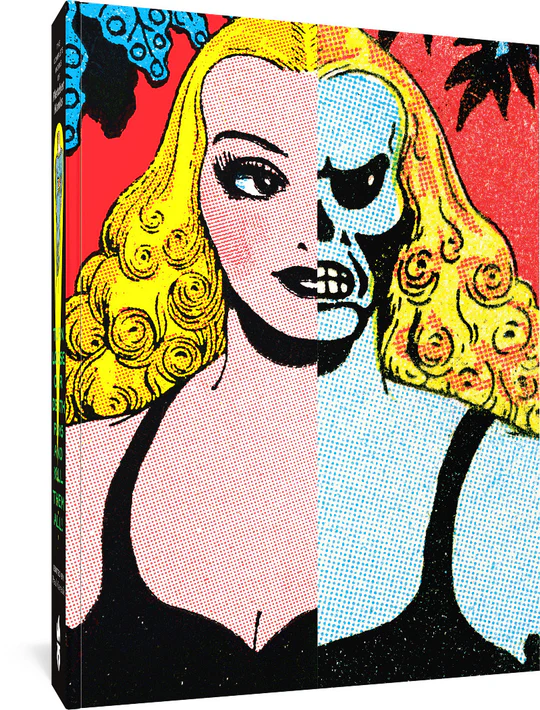
Now, fifteen years later, I find myself wondering how my opinion on a body of work could change so drastically. Our generous friends at Fantagraphics recently sent me a copy of the soon to be released softcover reissue of Turn Loose Our Death Rays and Kill Them All: The Complete Works of Fletcher Hanks and I found myself utterly enthralled by what was found inside.
I say it with absolutely zero hyperbole that Turn Loose Our Death Rays and Kill Them All provided me with a shot of the purest joy I’ve gotten from comics in the last few years.
The cringe I experienced over a decade ago was replaced with a thrilling shock at the unexpected directions these stories flew into. They are discomforting and throw a reader off balance when they are lived in for too long. Anyone that has read superhero comics learns the basic formulas and foundations of how stories orbiting around these costumed crime fighters are supposed to form. This is especially the case for books that came out during what they call the Golden Age. Fletcher Hanks either didn’t understand how these things were supposed to be done or didn’t care what anyone else was doing and so created some of the most idiosyncratic heroes and comic stories of the period.
Turn Loose Our Death Rays and Kill Them All collects stories from Hanks’ incredibly short career, spanning from 1929 to 1941, and stars a diverse cast of characters ranging from brawling loggers and space aces to jungle goddesses and super wizards. The stories are short, never more than five or six pages, but incredibly dense. Fletcher’s art has the same DNA as his contemporaries like Wally Wood, Basil Wolverton, or Jack Cole but feels just a little off. His men have impossible thick chests and just as improbable waistlines. Poses and facial features repeat in uncanny ways from one panel or page to the next. When punishment is doled out it is almost always done so in comically elaborate methods that end in on-the-nose ways like an O. Henry story gone wrong.
It would be easy to view these characters as novelties, kitsch oddities, or creative car crashes to gawk at, much like Jon Morris does in his book The League of Regrettable Superheroes: Half-Baked Heroes from Comic Book History, but there is something deeper at work in these pages. While it is obvious that Hanks was a hack trying to eke out a living through comics, he was also a borderline outsider artist who expressed an unknowable amount of his own personality on the page. His characters are aggressive and brutal, reflecting the bitter and abusive personality described in the introduction and closing comic by the editor of the book, Paul Karasik. The artist was just as much of an unclassifiable misfit as each and every one of his creations.
I hope there is another reality somewhere that comic books as a medium branched off more from the stories of Fletcher Hanks than the likes of Superman, Batman, or any of the myriad heroes that have shaped the mainstream for decades. A world where the stories are brutal and unexpected, where villains meet fates that equal parts absurd and on-the-nose, and where an artist can mold their singular view into bursts of twisted fantasy. Imagine the world of comics where THIS kind of renegade creativity took the wheel. It would be gloriously weird. I’m thankful that Paul Karasik and Fantagraphics chose to preserve this little window into that place.
While I loved this book, I also understand that it is not for everyone. I can still easily see the shadows of my past criticisms of the comics on every page. It’s an awkward read at times and it is sometimes impossible not to laugh at the utter absurdity of the events that take place in these stories. There are also a few artifacts of the time period that may trigger readers with a sensitivity to older and more toxic stereotypes.
I believe that it’s in those strange and offensive things that the art of Fletcher Hanks’ finds its appeal. There is a singular quality to the stories in Turn Loose Our Death Rays and Kill Them All but it is satisfying because you have to work to find the entire shape of it. For me, it took a decade to fully appreciate its varied dimensions. Hopefully it takes you far less time to find the best parts of the art within this book.
Turn Loose Our Death Rays and Kill Them All is available on November 4th, 2025 and can be preordered here.
About Author


